In order to compensate for the serious labor shortage in Japan, the number of companies employing foreign workers is rapidly increasing. However, an increasing number of small and medium-sized companies, in particular, are facing challenges in accepting foreign workers, such as inadequate environmental arrangements and lack of understanding among their Japanese employees.
In the international community, the “Code of Conduct on Business and Human Rights” was adopted by the United Nations in 2011, and now all companies, regardless of size, are required to respect human rights. Global companies, in particular, are required not only to implement their own “business and human rights” initiatives, but also to ensure that their supply chains (business partners) do the same, or risk difficulty in doing business overseas.
In Japan as well, in order to secure and retain excellent human resources, it is necessary to increase the satisfaction level of foreign workers and become a “company of choice” through efforts to respect human rights.
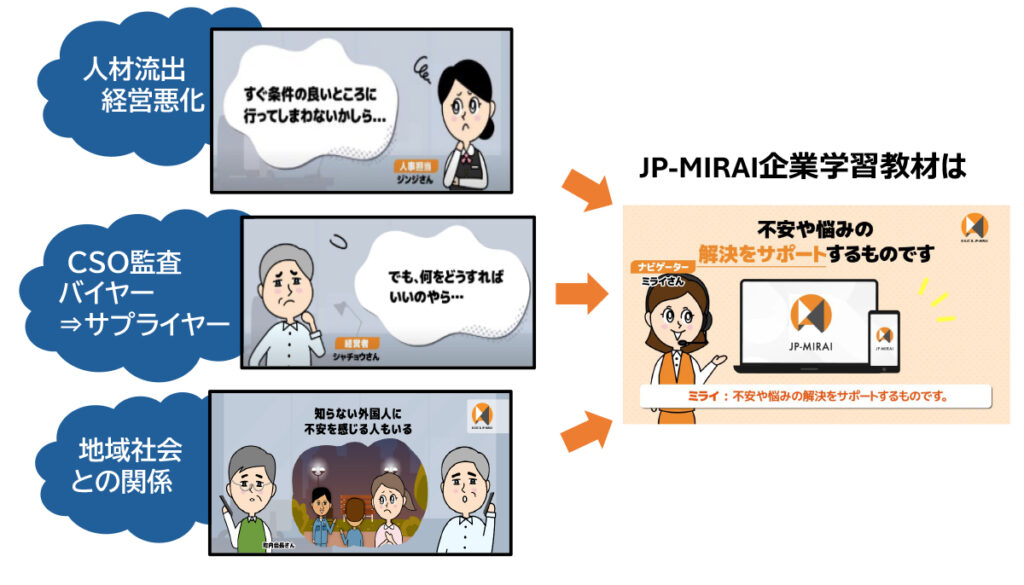
JP-MIRAI prepares and provides educational materials that explain in an easy-to-understand manner what companies employing foreign nationals need to know, so that they can take action to prevent and solve problems.
Furthermore, with the aim of creating educational materials that “people will want to use” and “people will use,” we will further enrich and disseminate the content in cooperation with corporate supply chains, local governments, industry associations, chambers of commerce and industry, and labor and social workers’ associations.
This course is designed primarily for those in charge of hiring and environment maintenance for foreign nationals in companies. The course consists of the modules listed in the table below and takes approximately 5 hours to complete. Upon completion of viewing all required modules, participants can take a comprehension test, and upon passing the test, a certificate of completion will be issued.
| Module | Length |
|---|---|
| Introduction – Introduction | 4 min. |
| The Basics – “Business and Human Rights Lecture” for those in charge by Sugita, Attorney at Law (15 pcs.) | 225 min. |
| Basics – Common Stories (6 pcs) | 12 min. |
| Fundamentals – Explanation of Important Topics (3 pcs) | 30 min. |
| Practical Application – For Practice in Small and Medium-sized Enterprises (1 piece) | 10 min. |
| Practical – Case Studies and Application Tips (6 pieces) | 30 min. |
| Comprehension test (20 questions) | 10 minutes |
The course is primarily designed for company managers and field managers. The course consists of the following components and takes approximately one hour to complete. Upon completion of viewing the required modules, you will be able to take a comprehension test, and a badge will be issued upon successful completion. Please refer to the ending video and proceed to the optional viewing of the basic “Common Stories” and practical “Case Studies and Application Tips” of the above standard course, or consider using the course materials in your company.
| Module | Length |
|---|---|
| Introduction – Introduction | 4 min. |
| The Basics – “Business and Human Rights Course” for Managers by Attorney Sugita (3) | 45 min. |
| Practical Application – For Practice in Small and Medium-sized Enterprises (1 piece) | 10 min. |
| Comprehension test (10 questions) | 5 minutes |
Introduction
– Introduction (4 minutes)
This section introduces the purpose, learning benefits, and structure of the material, as well as the characters in the animated material.
Standard Course Basic
– “Business and Human Rights Course” for those in charge by Attorney Sugita –
Lecture 7: Foreign Workers and Key Issues (15 min.)
This lecture is about trafficking in persons/forced labor/human rights violations.
Standard Course – Basic Course – Frequently Asked Questions
Episode 2 Tips for Communicating with Your Neighbors Neighborhood Trouble ( 2 minutes)
Cautions for use
The video materials provided here have been prepared as part of the Toyota Foundation’s FY2023 grant project for the specific theme “Acceptance of Foreign Human Resources and Japanese Society”.
The copyright of “Basics: Business and Human Rights Lecture” by Attorney Sugita for staff and managers belongs to Global HR Strategy (GHRS). All other videos are copyrighted by GJC and JP-MIRAI. You can view them by clicking on the viewing links, but copying, reproducing, or reprinting them in whole or in part without permission is an infringement of copyright.
JP-MIRAI paid membership is required to use this service.
Please contact the JP-MIRAI Secretariat for individual requests, such as when members wish to use the service at their own expense to their business partners, affiliated companies, or local companies.
All video materials are delivered to a Learning Management System (LMS). In addition to viewing the course materials, the LMS provides access to study guides, study history, results of comprehension tests, badge and certificate issuance history, and a variety of other reference materials, as well as communication functions among learners.
The LMS has a help desk (contact us) where you can ask questions that arise in the field.
As described in “How to Use” above, this service is basically provided as one of the services available to all domestic paying members of JP-MIRAI. For details, please refer to the Membership Guide. If you have any requests for the use of this service by your business partners, related companies, or local companies at your expense, please contact the JP-MIRAI Secretariat as we will consider your request on a case-by-case basis after hearing it from you.
The role of small and medium-sized enterprises (SMEs) in protecting the human rights of workers is attracting a great deal of attention.
JP-MIRAI’s educational materials focus on foreign workers, who are particularly vulnerable due to language, cultural, and institutional barriers, and provide easy-to-understand explanations of the special considerations necessary to ensure that their human rights are protected in the same way as Japanese workers, and encourage them to take action. The LMS for JP-MIRAI paid members will also guide them to the best related educational materials and tools so that they can learn in depth about the human rights of all workers in the supply chain, regardless of nationality, both domestic and foreign.
Please keep in mind that due to LMS specifications, if a second person logs in using the same ID while the first person is logged in, the first person will be forced to log out.
In addition, each ID is responsible for managing and displaying the study management records, inquiry forms, and bulletin board postings and descriptions, so we recommend that each learner use one ID, especially if they are aiming to earn a badge or certificate.
You can watch and learn on your computer, tablet, or smartphone.
The ID will be issued based on the registration information of the ID you are learning. If the ID is in the name of an individual, it will be issued in the name of the individual. If the ID is in the name of XX section, XX section, etc., it will be issued in the name of the department.
Currently (April 2025), there is no certification or certification system that we are collaborating with, but over the next two years, we plan to work with the National Federation of Social Insurance and Labor Consultants Associations (with which we concluded a collaboration agreement in November 2024) to create a certification system that utilizes this educational material and others.
At the same time, we also plan to promote the use of certification systems established by local governments.
We will do our best to accommodate you. Please contact the JP-MIRAI Secretariat.
Keiichi Ujiie
BHR Specialist, Global Compact Network Japan (GCNJ)
Emi Sugawara
Professor, Faculty of International Studies, Osaka University of Economics and Law
Shohei Sugita
Representative Attorney, Global HR Strategy (GHRS)
Ryusuke Tanaka
Expert, ILO Office in Japan
Masao Manjome
Professor, Tokai University
Japan International Trade Center for Cooperation in Human Resources (JITCO)
National Federation of Social Insurance and Labor Consultants Associations
In addition, we are working on the preparation and dissemination of this report with the cooperation of JP-MIRAI advisors and others who have provided diverse viewpoints through participation in workshops and opinion-exchange meetings.