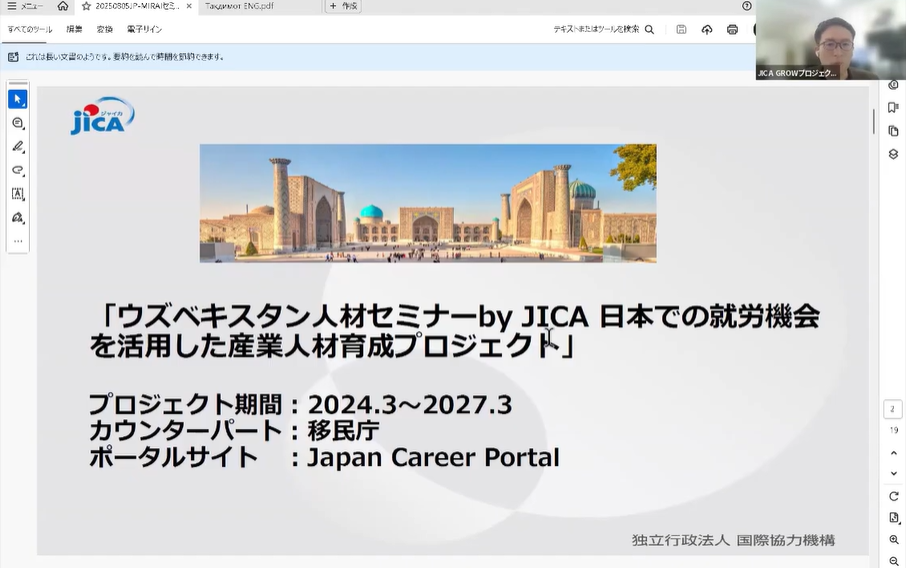
On August 5, 2025, a seminar on sending human resources to Uzbekistan was held jointly with the JICA Uzbekistan Office.
Uzbekistan has sent out a cumulative total of more than 1 million expatriate workers, mainly from Russia and South Korea, but the number of Uzbeks living in Japan is small, approximately 7,000, and the total number of technical interns and specified skilled workers is approximately 400.
In recent years, the number of Japanese companies visiting Uzbekistan has been increasing, and from March 2024, JICA will implement the “Industrial Human Resources Development Project Utilizing Work Opportunities in Japan (commonly known as GROW)” with the Migration Agency of Uzbekistan as the implementing agency, providing information through the Japan Career Portal and supporting collaboration between Japanese companies The project provides information through the Japan Career Portal and supports cooperation between Japanese companies and local institutions.
The following points were identified as issues related to sending out
The number of students studying abroad and staying in Japan for a short period of time is significantly high, and the number of people sent to work is limited.
There are issues regarding the quality and quantity of Japanese language education.
Of the 400 examinees for the specified skills from 2022 to 2024, only 176 passed the exam and only 32 entered Japan. The number of examinees is sluggish because it is difficult for those who pass the exam to find employment.
There are few local officials who are familiar with the Japanese system, business practices, and good employment opportunities, and there are only five sending agencies with experience in sending workers to Japan, which makes it difficult to find a good match.
In order to improve the above issues, the GROW Project is working on four pillars: (1) providing appropriate information through the portal site, (2) strengthening the capacity of sending organizations, (3) supporting cooperation between sending organizations, educational institutions, and Japanese companies, and (4) supporting employment promotion by expanding the scope of specific skill tests and promoting awareness of the system. Specific examples of cooperation with Japanese companies and organizations are increasing. Interested parties are encouraged to contact us at the contact information listed in the document.