The number of foreign workers in Japan is increasing every year, and companies are required to have a more responsible acceptance system. In particular, companies that employ foreign nationals and major companies that use their products and services (brand holders) are being urged by the international community to take responsibility for supply chain management and ethical recruitment.
JP-MIRAI provides practical support through collaboration to address human rights issues that are difficult for companies to tackle on their own.
Commitment to human rights required of brand holders
The main initiatives required of companies by international norms, such as the UN Guiding Principles on Business and Human Rights and ILO Conventions, are as follows
(1) Establishment of human rights policy: Clarification of corporate stance on respect for human rights (2) Implementation of human rights due diligence: Identification of risks and implementation of response measures (3) Establishment of remedy mechanism: Development of response channels when problems occur (4) Protection of workers’ rights in the supply chain: Clarification of responsibilities including subcontractors and related companies (5) ILO C181 (Private Vocational Brokerage Establishments Convention): Achieve ethical brokerage, including not allowing workers to pay brokerage fees
Role of JP-MIRAI and benefits for companies
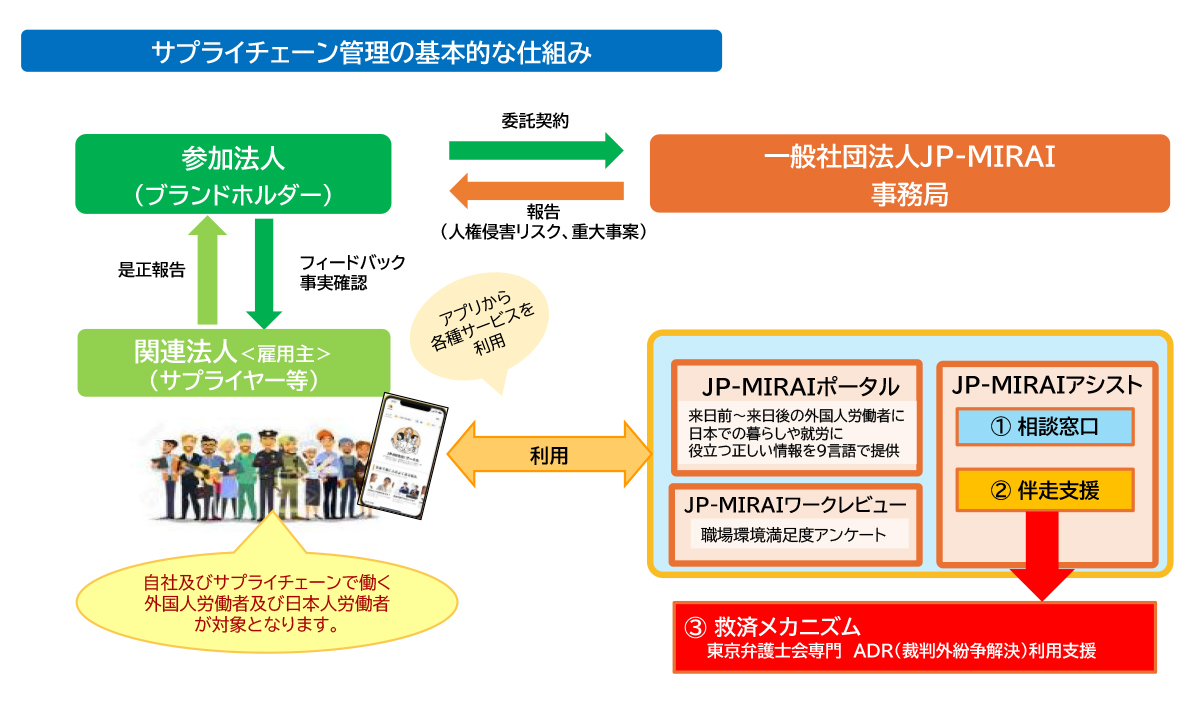
JP-MIRAI is a platform that provides practical tools and various types of support to help companies realize “responsible acceptance of foreign workers.
Practical Tools to Support Human Rights Due Diligence
– Provides practical assistance to companies that understand the importance of human rights due diligence but lack a mechanism for implementation. – In addition to brand holders, affiliated companies and supplier companies are supported through survey tools, provision of information, and expert advice so that they can identify their own human rights risks and work to improve them.
This will encourage the practice of respect for human rights throughout the supply chain.
Mechanisms for listening to rights holders
– JP-MIRAI Assist: Free consultation service in 23 languages to directly pick up the voices of foreign workers – Early detection of potential problems enables action before they become apparent
ADR (Alternative Dispute Resolution) as a remedy system
– Supporting prompt and fair resolution of disputes through the Tokyo Bar Association’s ADR system – Providing a solution that is less burdensome for both companies and workers
Business Overview
Support for participating companies
1. JP-MIRAI Assist (consultation service and relief mechanism)
・Multilingual consultation service available 5 days a week (Tue-Sat) from 10:00 to 18:00 in 23 languages ・Provides a remedy mechanism through the Tokyo Bar Association ADR system
2. JP-MIRAI Work Review (human rights due diligence support)
Provides workplace environment satisfaction questionnaires for foreign employees in 9 languages.
3. capacity building support for companies
Regularly hold meetings for exchange of opinions on the Corporate Collaboration Program (four times a year) ・Provide materials compiling various information and articles on “Business and Human Rights” every month ・Provide advisory services by legal counsel and supply chain management support by the secretariat’s advisors ・Provide videos introducing JP-MIRAI Assist Work Review (in 12 languages) and multilingual flyers (Providing a JP-MIRAI Assist Work Review introductory video (12 languages) and multilingual flyers