Foreign workers come to Japan with high hopes for Japan. Most of them have debts (average 540,000 yen) that they borrowed to pay for coming to Japan. It is said that for a considerable period of time before coming to Japan, they are forced to repay these debts, forced to save excessively, and unable to work with any peace of mind.
The Business and Human Rights and Guiding Principles (2011), adopted unanimously by the UN Human Rights Committee, refer to this as “debt labor” or even “forced labor.
When wages are lower than expected, the debt cannot be repaid, which is the cause of the disappearance of more than 6,000 technical intern trainees per year. Although the Japanese host companies did not intentionally create these situations, it can be said that the problem was caused by a desire for “cheap labor” and a lack of full understanding of the entire recruitment process.
Necessity for employers to bear the cost of recruiting foreign workers prior to their arrival in Japan, etc.
Recruitment costs are necessary to attract and retain good personnel.
If employers are willing to pay the recruitment and training costs for foreign workers to work in Japan, which have been generally borne by foreign workers in the past, it will lead to applications from excellent foreign human resources and enable the stable recruitment of foreign workers. In addition, after arriving in Japan, foreign workers will no longer have to worry about repaying debts, changing jobs to urban areas with higher salaries, or disappearing, allowing them to concentrate on their work, which will inevitably increase the retention rate.
2. it is a necessary cost to prevent forced labor
Japan’s technical internship system has been criticized by international organizations overseas as forced labor because (1) foreign workers are not free to change jobs, and (2) foreign workers must bear their own hiring costs prior to coming to Japan and work under the burden of debt (debt labor). Eliminating these shackles on foreign workers and being widely recognized as a human rights-conscious company that does not engage in forced labor will be an extremely important corporate strategy for companies doing business in the coming SDG era.
Business Overview
(Platonic) ideal (of how things ought to be, e.g. human rights)
It aims to achieve fair and equitable international labor migration (securing foreign workers) by respecting the rights of migrant workers and maximizing their abilities and opportunities in order to contribute to the economic development of both sending and receiving countries.
structure
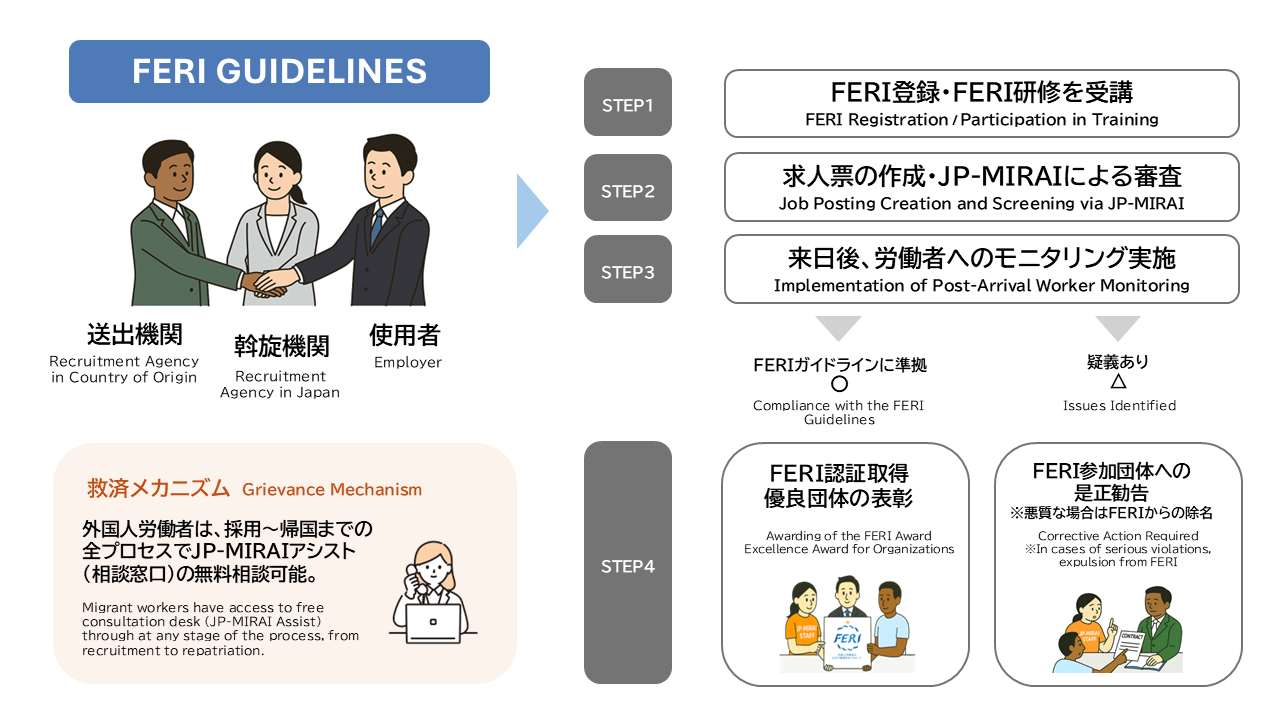
This is a private-sector initiative designed by JICA in cooperation with the ILO, RBA, and other organizations, and operated by JP-MIRAI, to promote “international-level recruitment of migrant workers” without charging high recruitment and related fees from foreign workers. FERI defines the roles and responsibilities of stakeholders in international labor migration, including sending organizations, intermediary organizations, and host companies (employers), as “FERI Guidelines.
The FERI Guidelines include important codes of conduct for fair recruitment, such as “prohibition of third-party involvement in recruitment” and “prohibition of bribes and entertainment,” etc. Since the prices are fair and do not include illegal costs (dark costs), they are easier for host companies to bear than existing schemes that assume refunds after arrival in Japan. Therefore, it is easier for the host company to bear the cost compared to the existing scheme that assumes refunds after the arrival in Japan. At FERI, emphasis is also placed on worker protection (relief) and motivation of participating blue-chip companies. For a more detailed explanation, see the video below.
The following explanatory materials and guidelines are provided for your useand if you agree, please proceed to the application. If you have any questions, please contact the FERI Secretariat.