In the Nagasaki/Saga section of this series, we will explore hints for creating an environment where foreign workers can live and work with peace of mind as members of the local community, based on practical examples from companies from the four perspectives of “housing,” “Japanese language learning,” “human resources development,” and “internal communication. This issue focuses on “human resource development.
Many companies that accept foreign workers have voiced concerns about human resource development, such as, “How can we train them to be effective in the workforce? In particular, in industries where on-the-job training tends to be left to workers on site, training systems are not in place, resulting in early turnover of foreign workers and delays in their conversion to a workforce.
However, this is not a challenge limited to foreign workers. As human resource shortages become more serious in all industries, many companies may be facing similar issues with young Japanese employees. This interview was filled with hints on how to rethink human resource development for the entire organization in the wake of the training of foreign workers.
Establishment of an education system started for foreign employees led to the retention of new graduates and young employees.
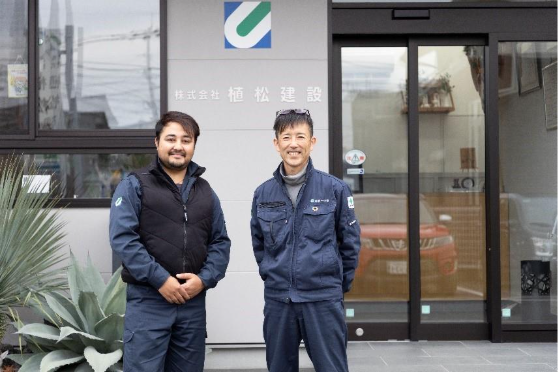
Uematsu Corporation (Construction/Highly Skilled Personnel)
When we started accepting foreign employees, 70% of our employees were in their 50s or older and had been in the industry for a long time. In such an environment where “it is natural to be able to do this,” young Japanese employees often suffered psychological damage due to inadequate training and soon quit. Naturally, we had to start from scratch to establish an educational system for accepting foreign employees, but we saw this as an opportunity to establish a system for accepting new graduates and to improve our team strength, and decided to establish a company-wide system.
Currently, interviews with the president are held four times a year for new employees, based on a sheet they fill out in advance to evaluate themselves, their seniors, and the company. Not only does this provide an opportunity for employees to objectively reflect on their own current situation and goals, but it also provides the company with an understanding of the current situation of new employees and material for responding to improvements in the company’s overall environment. We strive to build a relationship of trust through the experience of being able to say what we think, even as a newcomer, and having our opinions heard.
In addition, we have given young employees mentors, who provide training, encourage self-awareness, and proactively assign them to more challenging tasks. Nirmal, who has been with the company for four years, is also in charge of the site, and we have built a system that allows him to take on challenges without worry, providing support as needed in situations where discretion is required, such as negotiations with customers. Nirmal also plays an active role in recruitment by speaking at company tours and information sessions for international students.
Devices to increase motivation and competence
Toko Sangyo Co.
(Civil Engineering and Construction / Technical Intern)
In order to maintain and improve motivation, we place importance on having each individual set goals. We regularly review and verbalize their goals, such as “What do I want to learn through my work?
Orient-ING Co.
(Surveying/Highly Skilled Personnel)
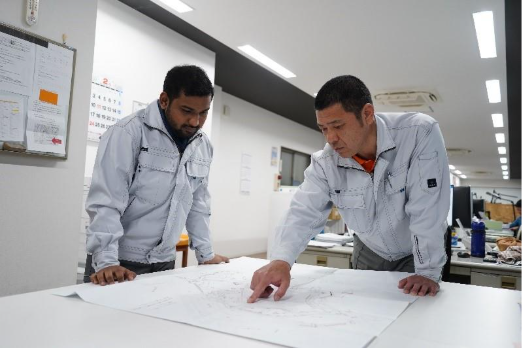
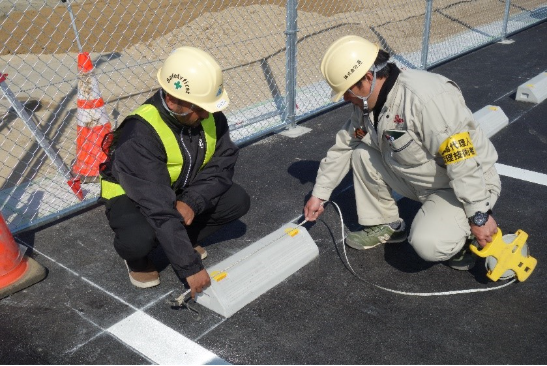
Since the industry is dominated by inexperienced workers, we have a system in place for new graduates to gain a full range of on-site experience in their first year and then attend a vocational school (at the company’s expense) in their second year, allowing them to intensively acquire on-site experience and knowledge. For non-Japanese employees, we would like them to first strengthen their Japanese language skills to the extent that they can study at a vocational school, and then have the same experience.
Toward New Development of the Company
D-SOL NSP Corporation
(IT/Highly Skilled Personnel)
Tanvir, who had IT skills and experience before joining the company, has contributed to creating a culture where employees learn from each other. He is proactive in sharing new perspectives and making suggestions during daily work and skill presentation sessions, and has a strong desire to grow. I feel that this “willingness to learn on one’s own” is a good stimulus, especially for new graduate employees.
In the future, I would like to explore a wider range of opportunities for them to play an active role, such as serving as a bridge when the company expands overseas.
Ryo Corporation
(Construction/Highly Skilled Personnel)
While we had originally accepted technical interns, our decision to accept advanced human resources (IT personnel) was aimed at promoting business improvement and DXing. The speed of development was recognized by the private think tank with which he worked during his internship. While an understanding of the construction industry is essential for system development, I expect that this work, in which he can utilize his strengths, will accelerate his learning of field work and terminology.
After the Interview: The Power of “Human Resource Development” of the Entire Organization Expands from the Training of Foreign Workers
The positive attitude of the companies was very impressive, as they see their efforts to train foreign workers not only as a mere system development, but also as an opportunity to review the “human resource development” of the entire company.
The innovations of the companies introduced in this report, such as support for careful goal setting, creation of an environment that encourages challenges, and work assignments that take advantage of individual strengths, can be applied directly to new graduates and young Japanese employees. As the shortage of human resources becomes more and more serious, it can be said that efforts to train foreign workers will ultimately enhance the company’s human resource development capabilities and lead to the growth of the organization as a whole.
(JP-MIRAI Tsubakihara)